
Complete Guide to Pickleball Shots
Whether you are a pickleball beginner learning the basics or a more advanced player who wants to add more shots to your repertoire so you can gain a competitive edge, understanding the full range of pickleball shots is essential.
When you move the ball around the court with specific shots, you create scoring opportunities and respond to your opponents. You can control the pace of a rally, gain court position, and create offensive opportunities. Each shot has a specific purpose and is most effective in certain situations. While there are many shots and variations in pickleball, not all shots are equally important.
This guide covers everything from primary shots that beginners should focus on first, such as serves, volleys, and dinks, to more advanced shots, such as topspin drives, backhands, and misdirection volleys. By mastering when and how to use each shot, you can keep your opponents on their toes and develop into a more accomplished player.
Pickleball Fundamentals
As a beginning pickleball player, there are a few fundamentals that you should initially develop. Before learning the “ins and outs” of various shot techniques, it is paramount to first have a “proper” grip and “ready” position. The grip and “ready position” represent the foundation from which to build. These core skills will provide a foundation for consistency, control, and efficient movement on the court.
The following are core fundamentals to master before diving into shot selection:
Grip
How you hold your paddle with an appropriate grip is important because it influences the angle of your paddle face – and, consequently, the flight and pace of the pickleball. A correct grip allows you to transition smoothly between forehand and backhand shots. Most shots in pickleball require the Continental grip. In addition, grip pressure matters, such as with the dink. It requires a loose grip.
Ready Position
One of the overarching keys to successful execution of any of your shots on the pickleball court is to be in an “appropriate” ready position. From this balanced, ready position, you want to be able to move quickly to the ball – in any direction.
Footwork
Having solid footwork puts you in the best position to get to the ball, successfully hit the ball, and recover after hitting it. Good footwork also allows you to do this efficiently – without unnecessary movement or an unnecessary expenditure of energy.
Why Shot Selection Matters
Shot selection is an important skill to perfect. Determining which shot to use in a game can result in winning a point or losing a rally. Choosing the right shot at the right time helps you stay in control and place your opponent in difficult situations.
Successful players don’t just drive every shot. They choose their shots strategically. They might slow the pace of the game with soft shots or play more aggressively.
Good shot selection improves your overall game by adapting to different opponents and situations.
Shot Selection Scenarios
Choosing the correct shot can give you a competitive advantage. If you need time to make your way to the Non Volley Zone, hitting a drive is not your best option, as it will reach your opponent quickly and not allow you enough time to move forward. Knowing which shot to use in certain situations can make or break a game.
Below are some situations that dictate what shot you should hit to give yourself the best advantage:
Situation | Best Shot to Hit | Why |
|---|---|---|
Serving | Deep Serve | Keeps Opponent Back |
Returning Serve | Deep Return | Keeps Opponents Back |
In Transition Area | Drop Shot | Gives You Time to Get to the Non Volley Zone |
High Ball | Overhead Smash | Offensive Opportunity |
Under Pressure | Reset | Neutralizes Attack |
Rally at the Non Volley Zone | Dink | Patient Shop to Create an Opening |
Opponent Out of Position | Speed Up | Initiates Attack |
Opponent at the Non Volley Zone | Lob | Forces Opponent Back |
Pickleball Shot Hierarchy
Pickleball Shot Library
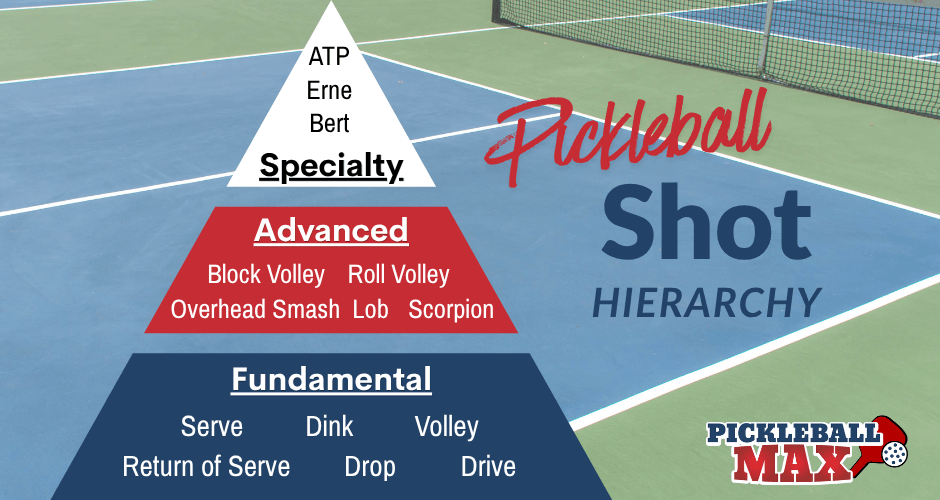
Below are the different shots you will want to use on the court. They are divided into Fundamental, Advanced, and Specialty shots.
Fundamental shots are the ones that every player should know and master, from beginner and up. To increase your rating, you will need to learn more advanced shots. 3.5 players begin experimenting with Advanced shots to varying degrees of success. Players who are rated 4.0 or above typically use many advanced shots.
Specialty shots are adrenaline-producing. They are the ones that Intermediate and Advanced players may add to their repertoire to gain an advantage.
Fundamental Shots
Dink and drop might sound like slang for bad players, but they are actually some of the essential shots that are fundamental for every player to know. These are the shots every beginner needs to master in order to advance.
Shot | Hit From |
|---|---|
Serve | Baseline |
Return of Serve | Baseline |
Dink | Non Volley Line |
Drive | Baseline or Transition Zone |
Drop | Baseline or Transition Zone |
Volley | Non Volley Line or Transition Zone |
Shots Beginners Should Learn First
Serve
A serve starts every rally. The serve is the only shot in pickleball in which you has complete control. The serve sets the tone for the rally. There are two types of serves – a volley serve and a drop serve.
Return of Serve
This is the second shot in pickleball. It is a shot that is hit once you receive a ball that has been served. Hitting an effective return of serve is critical to your team’s ability to earn side-outs.
How to Hit It?
You can drive a return, slice a return, or hit a soft return.
Dink
A dink is a shot executed from around your own kitchen line that lands in your opponent’s non-volley zone (kitchen).
Why It Works?
A well-executed dink will force your opponent to let the ball bounce. They will be forced to hit their next shot “up” to clear the net, making it very challenging for them to hit the ball hard and still keep it in the court.
How to Hit It?
Position yourself just 1-2 inches behind the kitchen line. Bend your knees and make contact with the ball comfortably in front of your body. Make sure your “swing” isn’t really a swing at all. Lift the ball with your shoulder. A dink has a short follow-through.
Drop Shot
A drop shot is a soft, delicate shot executed from essentially anywhere on the court that goes over the net and lands “harmlessly” in your opponent’s kitchen (non-volley zone) where they cannot “attack.”
When to Use It?
A drop shot is a great, strategic option anytime you and your partner are not at the non-volley line, but your opponents are.
Why It Works?
It gives you and your partner time to advance to your own non-volley line. It also forces your opponents to hit their next shot “up” to clear the net.
Third-Shot Drop vs Third-Shot Drive
Drop | Drive | |
|---|---|---|
Beginner Friendly | No | Yes |
Difficulty | Yes | No |
Creates Immediate Pressure | Sometimes | Yes |
Allows you to Get to the Kitchen | Yes | Not Always |
Preferred at Advanced Level | Yes | Sometimes |
Drive
A drive is a hard, flat groundstroke that is hit with pace. Drive shots are usually hit from the baseline or transition zone.
When to Use It?
Use a drive shot when you want to put pressure on your opponent.
Volley
A volley is simply defined as hitting the ball out of the air before it bounces. It frequently leads to rapid-fire exchanges from the non-volley line.
How to Hit It?
Keep your feet shoulder-width apart (perhaps slightly more). Square your shoulders with the net. Bend your knees slightly. Keep your bodyweight on the balls of your feet and the paddle positioned up and in front of your body.
Advanced Shots
Mastering dinks, drops, volleys, and drives is foundational in your journey to becoming a better pickleball player before adding more advanced shots to your repertoire.
Shown below are advanced pickleball shots to add to your arsenal. They are divided into offensive, defensive, and specialty shots.
Although some are frequently called upon during a match, others are simply intended to surprise your opponents – and, as such, are infrequently used. But all have a purpose.
Offensive vs Defensive Shots
Shots | Offensive | Defensive | Specialty |
|---|---|---|---|
Around the Post | yes | no | yes |
Backhand Punch Volley | yes | no | |
Backhand Slice Return of Serve | no | yes | |
Block Volley | no | yes | |
Cross Court Dink Volley | no | no | |
Cross Court Inside Out Forehand Drop | yes | no | |
Dink Escape | no | yes | |
Dink Shove Surprise Attack | yes | no | |
Erne | yes | no | yes |
Flamingo | yes | no | |
Half Volley | no | yes | |
Lob | yes | yes | |
Lob Return Drop | no | yes | |
Misdirection Forehand Volley | yes | no | |
Overhead Smash | yes | no | |
Short Angled Serve | yes | no | |
Scorpion | yes | no | |
Topspin Roll Volley | yes | no | |
Two Handed Backhand | yes | no |
Offensive Shots
Backhand Punch Volley
When to Use It?
Perhaps the most frequently executed shot during a match, the backhand punch volley is a great option for hitting volleys at your opponent’s feet or into a gap when the ball is approximately chest-high.
Why It Works?
With no backswing and full extension from the elbow, this shot is nasty.
Cross-Court “Inside Out” Forehand Drop Shot
This drop shot is hit from the odd side when your opponents are at the non-volley line, and you are near the baseline.
Why It Works?
With a little top spin that lands cross-court at the opponents feet on their backhand side, this shot will result in a shot that is generally un-attackable.
Dink Shove Surprise Attack
The dink shove relies on a bit of deception. When your opponent is straight across from you at the non-volley line, set up like you’re going to hit a dink shot, and then, at the last second, quickly “shove” the ball forward with your paddle straight at your unsuspecting opponent.
Why It Works?
The surprise shot jams your opponent, therefore, creating an easy put-away opportunity for your next shot.
Flamingo
The Flamingo shot attacks neutral balls out of the air. It helps you reach into the non-volley zone and take balls out of the air – all while staying balanced!
How to Hit It?
Pose like a flamingo – Balancing on the left foot, getting full extension forward, and using the back leg as a counter-balance. Hit down on the ball as hard as you can.
Why It Works?
This shot gives your opponent less time to react to your shot as the ball has a shorter distance to travel.
Misdirection Forehand Volley
When to Use It?
This is a very effective shot to hit when dinking cross-court, forehand-to-forehand, and your opponent hits their dink a little too far and about chest-high.
How to Hit It?
To execute this misdirection shot, open the paddle face, lay back your wrist and push the ball straight at your unsuspecting opponent straight across the net from you.
Why It Works?
You catch your opponent off guard by thinking the shot is going to their partner, all while it actually goes to them.
Overhead Smash
An overhead smash is a hard – and frequently angled – overhead shot executed off an opponent’s lob.
When to Use It?
This shot is intended to end the rally, if executed properly.
Short-Angled Serve
Why It Works?
If struck well, the short, angled serve that lands just beyond the non-volley line and will likely create a big gap in the opponent’s court if returned. You will then be able to hit a hard drive in the vacated space for an easy winner.
Scorpion
The scorpion is a counter-attack shot that is hit when you squat low to the court.
How to Hit It?
Squat low to the court, raise your paddle above your head, and smash the ball at your opponent’s feet or into the open court.
When to Use It?
The scorpion is a great counter-attack option when you are positioned at the non-volley line and your opponent speeds up the ball right at you – particularly when they speed up a ball that is low.
Topspin Roll Volley
When to Use It?
This is a great shot for its effectiveness and its relative “conservativeness.” When your opponents attempt drop shots or third shot drops, reach in when you can and hit a topspin volley that drives your opponent back and prevents them from advancing to the non-volley line.
Why It Works?
Your topspin roll volley will hit the court and “jump” at your opponent (because of the topspin) making their next attempt at a drop shot extraordinarily difficult.
Two-Handed Backhand
When to Use?
The two-handed backhand can be effectively used at any time – but particularly on those occasions in which you need or want additional power and/or stability – and you have adequate time in which to execute the shot.
How to Hit It?
The dominant hand should be placed on the bottom of the paddle – preferably in the continental grip. As you swing, your non-dominant hand should be doing most of the “work,” while your dominant hand is simply guiding the paddle.
Defensive Shots
Backhand Slice Return-of-Serve
The backhand slice return-of-serve is a fairly conservative, yet extraordinarily effective, shot.
Why It Works?
With the imparted backspin, the ball will stay very low to the ground, making the 3rd shot for the serving team difficult.
Block Volley
Squaring up your paddle to absorb an oncoming blast from your opponent. The block drops the ball harmlessly over the net and out of your opponent’s reach.
Why It Works?
It frustrates a banger and typically puts the ball out of their reach.
Dink Escape Shot
When to Use It?
For those instances in which your opponents have pulled you wide with a dink – and an around-the-post shot is not available – the best pickleball shot to get yourself back into the rally is a short, lofted dink into the middle of your opponent’s non-volley zone.
Why It Works?
This shot minimizes the angles for your opponent and gives you time to get back into position.
Half-Volley
Half-volleys are basically short-hop shots from the transition zone.
How to Hit It?
Loosen your grip and volley the ball softly into your opponent’s non-volley zone, then continue your advance to the non-volley line.
Lob
The lob shot can be both offensive and defensive. It is a shot that is hit over your opponent’s into the backcourt.
When to Use It?
If executed from the non-volley line – off either a dink or volley – when your opponents are leaning forward at their own non-volley line.
How to Hit It?
Hit the ball over your opponent’s non-dominate paddle shoulder. This makes an overhead smash much more difficult.
Lob Return Drop Shot
How to Hit It?
When returning a lob, pivot, turn, and chase the ball moving forward. Then come from behind-and-around the side of the ball to execute a drop shot that lands in your opponent’s non-volley zone.
Neutral Shot
Cross-court Dink Volley
The cross-court dink volley is when you take a dink shot hit by your opponent out of the air and softly volley it back cross-court so the ball lands harmlessly in your opponent’s non-volley zone so that it cannot be easily attacked.
Why It Works?
Taking the ball out of the air takes time away from your opponent. It also prevents you from backing up and retreating from the non-volley line.
Specialty Shots
Around the Post (ATP) Shot
How to Hit It?
Admittedly, this is a shot I under-utilize. When your opponent hits a severe angle and pulls you wide – frequently after a dink – blast the ball low and around the post into the open court. The ball does not have to travel over the net. The ATP shot will be an adrenaline rush and a rally-winner for your team!
Erne
An Erne shot in pickleball is a legal, “surprise-tactic” volley executed from outside the non-volley zone – in the out-of-bounds area to the right or left of the respective sideline – and close to the net that typically results in a downward strike of the ball and winning shot.
When Is It Used?
The Erne is typically executed in response to an opponent’s dink to the sideline that is made by the player straight in front of them.
FAQs
What is the difference between a dink and drop shot?
A dink and drop shot are both soft shots hit into their opponent’s kitchen area. However, a dink is hit from the kitchen line, while a drop can be hit from anywhere on the court.
What shots should beginners learn first in Pickleball?
Beginners should learn how to serve.
What shots does a player need to master to become a 4.0 in pickleball?
Players should master the drop shot to become a 4.0.
What are some advanced shots in pickleball?
The ATP, Erne, and Topspin Roll are some advanced pickleball shots.
What is a reset shot?
A block volley is a shot used to reset the ball.
Related Articles
The following posts are not only intended to help you execute a successful dink, drive, drop, and serve from a technical perspective, but are also intended to give you a better understanding and context of when, why, and under what circumstances each shot should be hit.
For a complete overview of the Shots mentioned in this guide, check out the articles below:
- 5 Tips for a Successful Pickleball Return of Serve
- 15 Pickleball Shots to Add to your Arsenal
- How to Return the Pickleball Lob Shot Effectively & Safely
- Pickleball Dink Shot – Add this Shot to your Repertoire of Strategic Shots
- Pickleball Drop Shot
- Pickleball Erne Shot
- Pickleball Half-Volley (Short Hop)
- Pickleball Lob Shot
- Pickleball Overhead Smash
- Pickleball Topspin (Roll) Volley
- Pickleball Two-Handed Backhand
- Pickleball Volleys
- Sting your Opponent with “The Scorpion!”
- The Flamingo – Balance, Counter-Balance & Attack!
- The 4th Shot
- The Nasty Nelson – Brilliant or Nonsensical
- The Pickleball Serve — What to Hit, When to Hit and Why to Hit Different Types of Serves
Final Thoughts
Hopefully, this guide helped clear up any confusion you may have as it relates to shots. Master the primary shots, then start adding some advanced shots to your arsenal. Your shot selection will enhance your game for the better. Which shot has worked best for you in your pickleball journey? Please let us know in the comments below.
See you on the courts.