
Early Tournaments for PickleballMAX
This is a compilation of early blog posts about tournaments that Todd either refereed or played in.
Wearing Black-and-White Pinstripes on the Pickleball Sidelines
August 2015: As the Republican presidential contenders are busily prepping for their first nationally-televised primary debate this evening, I am also spending the day preparing — not for any potential political zingers I can throw at my opponents — but rather, for my first forray into score-keeping and “refereeing” a USAPA Sanctioned Pickleball Tournament.
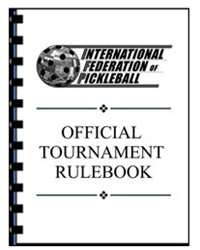
Although I don’t yet qualify to participate as a player (it’s an over-50 tournament), I am nevertheless excited to be part of the action on the sidelines wearing the “black-and-white pinstripes.” As part of the USAPA membership level that I purchased earlier this year, I was provided a copy of the International Federation of Pickleball Official Tournament Handbook. What better way, I thought, to brush up on pickleball doubles scoring and the rules of pickleball than to review this guide? As I was thumbing through the 56-page handbook, I thought it may be helpful to highlight four different rules and their interpretations that frequently arise on the pickleball courts — and will likely be relevant tomorrow.
Four Relevant Pickleball Rules that can Confuse Even the Tournament Player
4.A. Serve Motion. The serve must be made with an underhand stroke so that contact with the ball is made below waist level (waist is defined as the navel level). (revised Feb. 1, 2013)
4.A.1. Underhand Defined. The arm must be moving in an upward arc and the paddle head shall be below the wrist when it strikes the ball (paddle head is that part of the paddle excluding handle. The highest point of the paddle head cannot be above any part of line formed where the wrist joint bends). (revised Feb. 1, 2013)
9.B. A fault will be declared if, in the act of volleying the ball, a player or anything the player is wearing or carrying touches the non-volley zone or touches any non-volley line. For example, a fault will be declared if, in the act of volleying the ball, one of the player’s feet touches a non-volley line. IFP Comment: The act of volleying the ball includes the swing, the follow-through, and the momentum from the action. If the paddle touches the non-volley zone during the swing, it is a fault regardless of whether the touch occurred before or after contacting the ball. (Added January 15, 2012)
12.A. Carry and Double Hits. Balls can unintentionally be hit twice or “carried”, but this must be during a continuous, single-direction stroke. If the stroke is not continuous, not single-direction, or if it is a definite second push, the hit is illegal. (revised April 1, 2011)
12.K. Shots Around the Net Post. If a ball hit at an angle bounces in the court and travels beyond the sidelines, a player may return the ball around the outside of the net post. The ball does not need to travel back over the net. In addition, there is no restriction on the height of the return. For example, a player may return the ball around the net post below the height of the net.
Looking Forward to Tomorrow’s Tournament Action
If you’re playing and you see me standing on the sideline with a clipboard, don’t try to “pull one over on me.” I’ll have the official tournament rulebook with me — and I won’t be afraid to use it! See you on the courts.
Twelve of Thirteen Matches Refereed with No Controversy – It’s that 13th Match that Proved to be “Unlucky”
August 2015: This previous weekend I had the opportunity to debut my refereeing “skills” in a USAPA Sanctioned Pickleball Tournament. In fact, I refereed 13 total matches over the course of the day last Friday and Saturday. In preparation for donning the “black-and-white pinstripes,” there were four pickleball rules that I studied and hypothesized may be a point of contention during one or multiple matches – the underhand serving motion, momentum and the non-volley zone, carry and double hits and, finally, shots around the net post. I was prepared.
12-Up, 12-Down
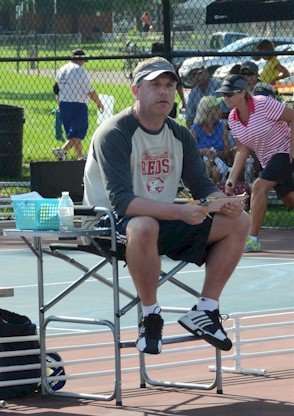
The matches on day 1 and thoughout the morning of day 2 went smoothly without issue. I called the scores clearly and loudly. I figured out what to do with the clothespins that had “1” written on one side and “2” written on the other. I even managed to keep track of the player positions – even when the players themselves were confused. Twelve games up, twelve games down with no “controversy.” Of course, it didn’t last.
Unlucky Match #13 — A Little Controversy
It wasn’t a huge controversy – but it was “controversy” nonetheless. Here’s what happened – and, of course (insert reference to Murphy’s Law here), it happened late in the match at a fairly critical juncture.
The ball was served. Just prior to the return, the returner’s partner yells “hold ‘em” [as if saying to the partner, “ let’s win this point so that we can get a sideout and get the serve back again”]. Upon hearing the returner’s partner yell “hold ‘em” the serving team stopped playing and once the return was made, absolutely no effort was made by the serving team to execute the 3rd shot. The returning team thought they had won the point because they executed the return and the 3rd shot by the serving team was not attempted. They went on to say that yelling “hold ‘em” was a form of team communication – which, even according to Rule 12.H, in-and-of-itself is generally not considered a distraction. Of course, the serving team had a different opinion. However, the referee’s decision is the only opinion that really matters. My decision was to replay the point.
Why I Replayed the Point
As a referee, there were two considerations I factored into my decision to replay the point: (1) Absolutely no effort was made by either player on the serving team to hit the 3rd shot. They literally stopped playing upon hearing “hold ‘em” from the returning team. (2) “Hold ‘em” sounds a lot like “hold-up.” My guess (it’s admittedly a judgment call) is the serving team, upon hearing “hold ’em,” stopped play because they thought a ball may be posing a danger to one of the players somewhere on the court. Replaying the point seemed to me to be the best and fairest option for both teams. It also seemed to be the most commonsensical thing to do.
Rule 12.H — Distractions
There’s a fairly lengthy discussion about Rule 12.H (Distractions) in the IFP Official Tournament Handbook. The last 3 sentences seem to be most relevant to the situation:
“Note: In Doubles, team communication shall not normally be considered a distraction. However, loud communication at the time the opponent is about to strike the ball may be considered a distraction. If in the judgment of the referee, a distraction has occurred, it shall result in the loss of the rally.”
In this case, my judgment call was that it was, indeed, a distraction. However, I didn’t award the serving team the point – rather, I had them replay the point.
What Say You?
Did I make the right call? What say you? Has this exact scenario ever happened to you? Have a great weekend everybody. See you on the courts!
Ton Poppas says:
May 14, 2016 at 8:14 pm Edit
You made the right decision. Any “True” sports person would replay the point
Reply
PickleballMAX says:
May 15, 2016 at 8:04 am Edit
Thanks, Ton, for your comment & feedback. Enjoy your day — and hopefully, pickleball will be a part of it!
Burt says:
September 14, 2015 at 9:17 pm Edit
Here’s the important part of 12H: “However, loud communication at the time the opponent is about to strike the ball may be considered a distraction. If in the judgment of the referee, a distraction has occurred, it shall result in the loss of the rally.”
They communicated loudly. The opponents were about to strike the ball. The opponents stopped. Why did they stop? They were distracted. Why were they distracted? Because of the opponents’ loud communication. End of inquiry. The communication caused a distraction. It’s a fault and the serving team scores a point.
p.s. If I were refereeing this match and were not positive of the result, I would not have guessed. I would have called over the tournament director and sought advice.
Reply
PickleballMAX says:
September 14, 2015 at 9:35 pm Edit
Hi Burt, Thanks much for your feedback. You’re absolutely correct on all counts. The serving team should have been awarded the point. Should this scenario happen in future matches, I now know exactly how it should be called. (Luckily, the serving team did, in fact, win the match). Ironically, it was the receiving team that was “upset” (not really) that the point was replayed. Go figure. Thanks again. See you on the courts!
TAB says:
September 9, 2015 at 2:56 pm Edit
With less than a year of PB experience, I would agree with the replaying the point. Where I play most, I suggest replaying points when there is an issue – good or bad for my side. We’ll see what happens if I play in a tournament. I would hope the same decision.
Reply
PickleballMAX says:
September 9, 2015 at 3:50 pm Edit
Thanks for your comment, TAB. Glad that you’ve picked up the game in the past year. Fun times! See you on the courts!
Sharon says:
August 18, 2015 at 10:37 am Edit
this article is too funny- you made the right call (to re-play) this situation happens a lot- especially with inexperienced players in tournament situations- always good to remind/warn them and Re-play the point- Keeps everyone smiling on the courts :-)
Reply
PickleballMAX says:
August 18, 2015 at 10:56 am Edit
Thanks, Sharon. Replaying seemed to be the commonsensical thing to do — although, officially, I probably should have awarded the point to the serving team. Replaying did, for the most part, keep everybody happy and “smiling!” ;-)
2015 Pickleball Tourney in Royal Oak, MI — A Recap (Well, sort of!)
September 2015: From August 21-23, 2015, in one of the most anticipated tournaments of the year – at least for me — Royal Oak once again played host to its Annual Skill Level Pickleball Tournament on the Pat Sullivan Courts. Over the course of the 3-day event, I was able to enjoy the tournament as part competitor – playing in the 4.0 Men’s Doubles with one of my good friends from Woodside Bible Church – and part spectator, watching several of the game’s top pickleball players battle it out for weekend supremacy.
Pickleball Clinic – Tournament Preparation On The Upton Courts
On Wednesday, August 19, just two days prior to the official start of the tournament, 50 players – including yours truly – took advantage of a 1-hour clinic hosted by Kyle Yates (#2 ranked pickleball player in the country) and Scott Tingley, pickleball instructor from Punta Gorda, FL. With this “professional” instruction, I was anticipating the opportunity to stand on the medal stand on Sunday afternoon, but alas, it wasn’t to be. ;-) Most of my weekend was relegated to spectating behind the fence.

5.0 Mixed Doubles
While I enjoyed watching all levels of competition, I was particularly drawn to the 5.0 Mixed Doubles matches. The precision, execution, and, most impressively, consistency of their shots was immediately evident. Those factors, amongst other considerations, are what separates a 5.0 player from a 4.0 player. To give you a flavor of the 5.0 Mixed Doubles, I have included a clip of one of the points. In the near court are Rafael Siebenschein and Simone Jardim and in the far court are Kyle Yates and Corrine Carr.
Kyle Yates, Corrine Carr, Rafael Siebenschein and Simone Jardim — Three of the Four Have a Michigan Connection!
Having met University of Florida student and 20-year old, Kyle Yates, at Wednesday’s Pickleball Clinic, I was somewhat familiar with his junior tennis background and prowess on the pickleball courts. I was curious to learn more. I was also curious if the other three picklers from the Mixed Doubles Match that I videotaped had similar backgrounds and, indeed, they did. Here’s what I found:
- Kyle Yates – As a high school tennis player at Cypress Lake High School in Fort Myers, FL, he reached states three consecutive years and made the finals as a junior. Currently the #2 ranked pickleball player in the country.
- Corrine Carr — Played high school tennis, winning three singles and three doubles conference titles along with two doubles and one singles state championships. Golf seems to be her first love, however. In 2009-2010, she posted the 10th-best scoring season in University of South Carolina Gamecock women’s history at 74.85. She is currently a Finance Ph.D. Student at Michigan State University.
- Rafael Siebenschein — Established a Calvin College (Boo! Go Hope!) career record for tennis victories with a 128-34 overall mark, finishing 66-15 in singles play and 62-19 in doubles action. Named to the All-MIAA second team his senior year.
- Simone Jardim – In 2015-15, Simone Jardim will enter her eighth season as the women’s tennis head coach at Michigan State University. Go Green! As a player at Fresno State University, she earned All-America honors twice in doubles play and played in the NCAA Tournament in both 2001 and 2002, finishing both campaigns ranked top 10 nationally. Earlier this summer, she and MSU associate head coach, Tyler Faulkner, won the U.S. Open Midwest Qualifying Tournament in mixed doubles before falling in their bid to secure a wild card entry to compete in this year’s US Open.
While it was a bit discouraging to not advance as far as I had hoped, it was entertaining, fun and it was a learning experience, nonetheless. It was also pretty cool to watch many of pickleball’s who’s who compete in our “backyard.” In the coming weeks, I will be sharing many of the concepts/strategies that were reinforced after watching some of the game’s most talented players. Looking forward to practicing and, ultimately, implementing these skills & strategies next year. Watch out Kyle, Corrine, Rafael, and Simone! :)
See you on the courts!


Pickleball Doubles Strategy Blueprint
Jigsaw Health – Discount Code!
Use Code “PickleballMAX10” at Checkout for 10% off your Jigsaw Order.
RIA Performance Eyewear