
Pickleball Faults: Avoid Them at All Costs
This post has been updated in 2026 according to the USA Pickleball Official Rulebook (2026).
We have all been there as players. We hit the perfect shot, or so we thought. Our toe touched the kitchen line, or the ball landed just beyond the baseline. Either way, it was a fault. Understanding pickleball faults is essential if you want to avoid giving away easy points. Whether you’re a beginner or an experienced player, knowing exactly what counts as a fault will improve your chances of winning.
Let’s break down some of the major and more minor faults in pickleball, with examples and explanations based on the official rules from USA Pickleball.
What is A Fault in Pickleball?
According to the official USA Pickleball rulebook, a fault in pickleball is any action that stops play because of a rules violation.
- If the receiving team commits a fault → the serving team wins a point
- If the serving team commits a fault → they lose the serve (or side-out)
Common Pickleball Faults
As a pickleball instructor who watches many beginner rec games, I always notice some common faults. Here are some of the most frequent faults I typically see in a game:
- Hitting the ball into the net
- Hitting the ball out of bounds (beyond the court lines)
- The ball bounces twice on your side of the net before being hit
- Volleying while stepping in the non-volley zone (kitchen)
- Violating the two-bounce rule after a serve
- The ball hits a light or other permanent object before bouncing on the court
- Carrying the ball
Who Calls a Fault?
According to rule 9.B.2 and 9.B.3.a, players are expected to call faults on themselves or on their partner as soon as the fault is committed or detected. It must be called before the serve is hit to begin the next rally.
If a player and their partner disagree on a call, the call is decided in favor of their opponent.
If both players from the “offending” team deny a non-volley zone infraction or service foot fault, a replay occurs. Check out our post – Disagreement Over a NVZ Infraction in a Non-Officiated Match for more details and scenarios about who calls a fault.
Serving Faults in Pickleball
Serving faults are one of the most common sources of errors—especially for beginners.
Foot Faults on Serve
- Stepping on or over the baseline during the serve
- Foot outside the imaginary extension of the sideline or centerline
Incorrect Serve Placement
- Ball does not land diagonally in the correct service box
7.E.1 Serve Lands Out of Bounds. When a served ball lands outside the correct service court, it is a fault against the server. - Ball lands in the kitchen or on the kitchen line
7.E.2 Serve Lands in Non-Volley Zone. When a served ball lands in the non-volley zone, it is a fault against the server.
Illegal Serve Motions
An illegal serve motion is dependent on the type of serve you use. A drop serve doesn’t have as many illegal criteria as the volley serve.
- Paddle contact above the waist during a volley serve
- Paddle not moving in a clear upward arc during a volley serve
- Having your wrist above the highest point of the paddle head when the paddle contacts the ball during a volley serve
- Propelling the ball upward or downward during a drop serve
Although illegal serve motions are incorrect and considered a fault according to rule 7.C.5 and rule 7.D.6, they cannot be enforced. You can mention it to your opponent, but if they disagree, you can’t enforce it according to rule 9.B.4.
Other Serve Faults
- Ball hits the net and does not land in the correct service box
- Serving out-of-turn
- Serving before the score is called
-> Check out our guide on Pickleball Serve Rules for more information.
Kitchen (Non-Volley Zone) Faults
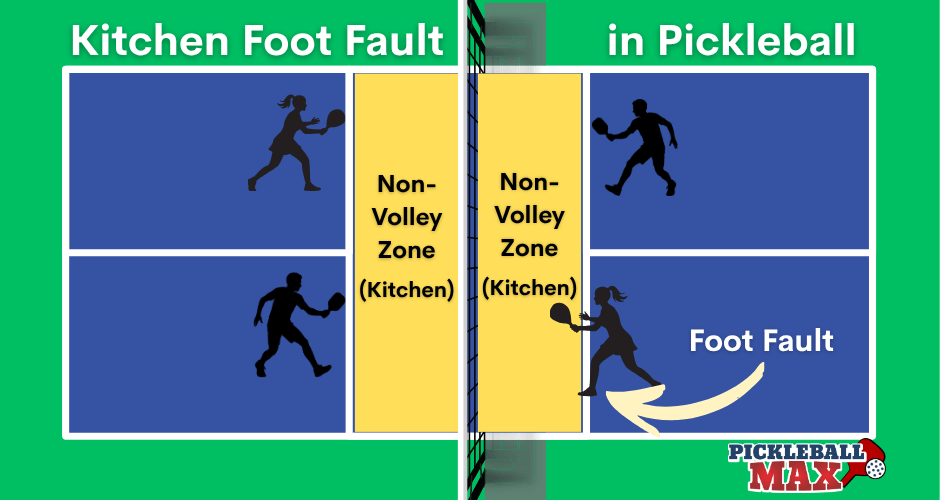
The court area 7 feet on both sides of the net is called the non-volley zone (kitchen). Many faults in pickleball are related to the kitchen.
Volleying in the Kitchen is a Fault
A player is allowed to be in the kitchen anytime; however, they must stay out of the kitchen when volleying the ball out of the air. The following are kitchen faults.
- Hitting the ball out of the air (volleying a ball) while standing in the kitchen
- Touching the kitchen line when volleying
- Stepping into the kitchen after a volley due to forward momentum
-> Check out our guide on Pickleball Kitchen Rules for more information.
Two-Bounce Rule Violations
The two-bounce rule must be followed at the start of every rally. If it is not, it is considered a fault.
Faults Include
- Volleying the serve return
10.A.1 No Bounce by Receiver. When the receiver does not allow the serve to bounce before hitting the ball, it is a fault against the receiver. - Volleying the return of serve before it bounces
10.A.2 No Bounce by Serving Side. When the server or server’s partner does not allow the return of serve to bounce before hitting the ball, it is a fault against the serving side.
While there is a two-bounce rule, there is also a double bounce rule, which, if not adhered to, is considered a fault.
Double Bounce Violation
While players sometimes interchange the terms “two-bounce” and “double bounce”, they are actually two different rules and can be two different faults.
- 10.B.1 Double Bounce. When a player fails to return a ball before it bounces twice, it is a fault against the player
Net and Contact Faults
The net can be a friend or foe. It can almost be considered a third player at times. While the net can be a source of many faults, your opponents can consider themselves lucky when it happens.
- Touching the net with your paddle or body while the ball is in play
13.G.1 Player Contacts Net or Net Support System. When a player or anything that is worn or carried by the player contacts the net or net support system while the ball is live, it is a fault against the player. - Paddle or body crossing the net before hitting the ball (unless legal follow-through after contact)
13.I.1.a Player Crosses Plane of Net Before Hitting Ball. When any part of a player or anything that is worn or carried by the player crosses the plane of the net before the player hits the ball, it is a fault against the player - Hitting the net post with the ball
Hindrance and Distraction Faults
These are less common but important to note. According to Rule 9.C, 9.C.1, and 9.C.2, a called hinder results in a dead ball. Any player may call a hinder.
Examples
- Yelling during an opponent’s shot
- Waving arms to distract
- Calling “out” incorrectly during a rally
You can claim a replay if a hindrance affected your team’s ability to play the ball.
Tips to Avoid Faults
While some faults can’t be avoided, others can. Here are a few tips to help you avoid faults so you can keep the rally going.
- Practice serves with proper technique — either drop or volley
- Give yourself plenty of space behind the baseline so you don’t commit a foot fault on your serve
- Always check your feet near the kitchen line. Keep toes off!
- Communicate with your partner
- Keep your head in the game
FAQs
What happens if partners disagree on a line call or other potential faults?
Any disagreement between partners on a fault call (such as a line call) will be decided to the benefit of their opponents.
Who’s responsibility is it to call faults?
Players are expected to call faults on themselves or on their partner as soon as the fault is committed or detected.
A team calls a non-volley zone fault on you. However, you do not believe you committed the infraction. Now What?
When there is any disagreement between teams about a non-volley zone fault or service fault, the rally must be replayed.
A team says you committed a fault (not a non-volley zone fault or a service foot fault). Can they Enforce it?
If a player believes an opponent has committed any type of fault other than a non-volley zone fault or a service foot fault, they may mention the specific fault to the opponent upon completion of the rally, but they have no authority to enforce the fault. The final decision on fault resolution belongs to the player that allegedly committed the fault.
Related Guides
For a complete overview of the rules mentioned in this guide, check out the ones below:
- Complete Guide to Pickleball Rules
- Pickleball Serving Rules Explained
- Kitchen Rules in Pickleball
- Pickleball Scoring Rules
Final Thoughts
Mastering pickleball faults is one of the fastest ways to improve your game. By eliminating unforced errors and understanding the rules, you’ll keep rallies going and hopefully win more points.


Pickleball Doubles Strategy Blueprint
Jigsaw Health – Discount Code!
Use Code “PickleballMAX10” at Checkout for 10% off your Jigsaw Order.
RIA Performance Eyewear