
Pickleball Outdoor Balls, Indoor Balls and USAPA Amended Rules
This post lists rule changes from prior years. To view the current year (2026) rule changes, please click here.
From a weather perspective, it’s been a strange last couple of months. One weekend plummeting temperatures are forcing pickleball play indoors – and the next weekend rising temperatures are giving pickleball players everywhere the opportunity to play outside for that “one final time” before the snow falls. Rotating between indoor and outdoor play, however, can take a bit to get used to – wind vs. no wind, one set of lines vs. multiple sets of lines, sun vs. no sun, and a host of other variables that are either non-existent or exacerbated when playing either indoors or outdoors.
The actual pickleball ball – a hollow, plastic ball with holes – is a significant variable as well. As you may know, balls are categorized as either indoor or outdoor. Playing with the “wrong” ball may yield “interesting” results.
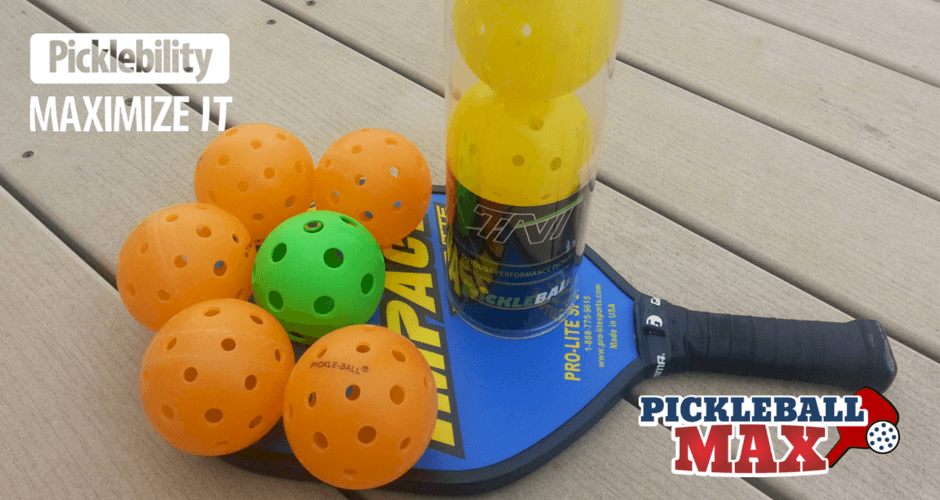
Outdoor Balls
The “outdoor” ball – because it is slightly heavier (about an ounce heavier), harder, and has smaller holes – travels significantly faster than the indoor ball. Unfortunately, it also bounces a little lower and is a little more difficult to control. To enhance the durability of the ball, outdoor pickleballs have thick wall construction.
Indoor Balls
Indoor balls are lighter, softer and have larger holes than outdoor balls. Because of these characteristics, indoor balls come off the paddle a little “softer,” are easier to control, and typically result in longer rallies. On the other hand, it is more difficult to hit the ball with the velocity required to put away that “easy” volley.
USAPA Amended Rules for Balls (and Paddles)
Here is a listing of all current (as of 2019) USAPA/IFP Approved Tournament balls. Because of the proliferation of new balls (and paddles) on the market, the USAPA frequently amends its rules in an effort to “maintain the traditional nature (finesse versus speed) of the sport.” The rules address the specification changes of the balls in the areas of ball construction, size, weight, bounce, hardness, and design.
Who would have thought – 50 years ago – that there would be so many variables in the game as it relates to the plastic pickleball? I guess that’s what it means to be one of the fastest-growing sports in America.
Please let me know what your favorite indoor and outdoor ball is.
For more information on pickleballs as of 2019 — and a robust buying guide for balls, please click here.
See you on the courts!





Regarding the actual ball, indoor vs outdoor. In the Villages we use an outdoor ball which is yellow and has both large and small holes in the same ball. Today some one said that balls with just one set of holes (the larger size) were “officially” OK to use. Does the USPA officially sanction that ball. I believe it was an ONYX-orange colored for tournament play?
Hi Ernie,
You can find a listing of the USAPA approved balls by going to http://www.usapa.org > Rules & Referees > Approved Ball List. That will take you to a PDF of the most recent approved ball list.
Hope this help!
Todd
Today Cheryl had her Picklebility shirt on — Looks Great!! Love your PickleballMAX site too👍
Thanks, Sharon, for your kind comments. Look forward to seeing and playing with you in the new year.
I just played with a new ball last week that a friend brought to an indoor facility. It is an Onix ball. It is designed to be used indoor & outdoor. The holes are small like outdoor but it is not as hard as outdoor or as soft as indoor. Have you seen or heard about it? I liked it for indoor play.
Thanks, Dave, for the feedback. I have, indeed, heard of the ball you are referencing — although I don’t believe I’ve ever used it in a match.