
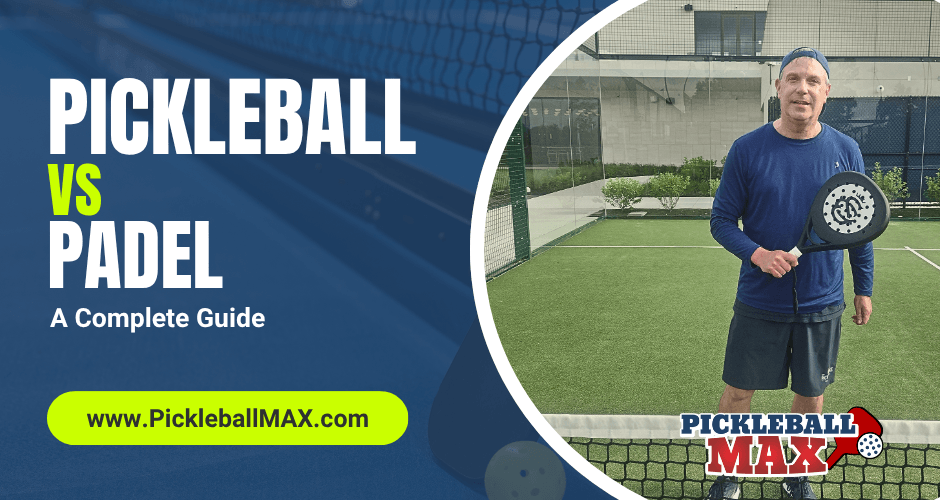
Pickleball VS Padel: Key Differences and Similarities
Pickleball is played on an open court. Padel is played on an enclosed court. Both are enjoyable and growing sports!
While both pickleball and padel belong to the “racket category” of sports and are played on a court significantly smaller than a tennis court – pickleball on an “open court” and padel on an enclosed court consisting of heavy duty tempered glass walls and wire mesh grid fencing – significant differences exists as it relates to the court, equipment, scoring and strategy.
The Growth of Pickleball and Padel
Pickleball, invented in 1965 on Bainbridge Island, WA, and padel, invented in 1969 in Acapulco, Mexico, are seemingly traveling similar paths. After all, pickleball is widely accepted as being the fastest-growing sport in the United States, while padel is argued to be the fastest-growing sport in the world on a global scale.
According to the Sports & Fitness Industry Association, 24 million Americans played pickleball in 2025, while 1.07 million Americans played padel. On a global scale, however, padel is played by an estimated 35 million people.
Similarities Between Pickleball and Padel
Because of the smaller court footprint and because both pickleball and padel are primarily played as doubles, both sports tend to be quite social – as each player is in close proximity to his/her partner and opponents. Both are also relatively easy to learn for those just beginning their pickleball or padel journey.
While I have been playing pickeball since 2015, I only recently experienced the padel phenomenon first-hand. From the court, to the paddle, to serves, scoring and strategy there are, to be sure, similarities between pickleball and padel. Yet there are also significant differences between the two. While some are visible and obvious, others are much more nuanced.
Pickleball VS. Padel Comparison
Pickleball | Padel | |
|---|---|---|
Year Invented | 1965 | 1969 |
Where Invented | Bainbridge Island, WA, USA | Acapulco, Mexico |
Invented By | Joel Pritchard, Bill Bell, Barney McCallum | Enrique Corcuera |
Why Invented | Past Time for Kids; Entertain Bored Children | Property/Space Constraints; Neighborhood Courtesy |
Official Rulebook | Official USA Pickleball Rulebook | International Padel Federation |
Net Height | 34″ @ center, 36″ at post | 35″ @ center, 36.2″ @ post) |
Court Dimensions | 44′ x 20′ (Open court) | 66′ x 33′ (Enclosed Court) |
Court Type | Open Court. No Walls. | Enclosed Court Consisting of Heavy Duty Tempered Glass Walls & Wire Mesh Grid Fencing. |
Ball | Plastic Ball with Holes (similar to wiffle ball) | Pressurized Rubber Ball (similar to tennis ball) |
Paddle/Racket | Solid. Stringless. | Solid. Stringless. Perforated Surface. Includes Wrist Strap. |
Scoring | Side-out Scoring. Games Typically Played to 11, Win by 2 | Tennis Scoring (15/30/40/Game) including Deuce & Ads. |
Number of Serve Attempts Permitted | 1 | 2 |
Example Shots Unique to the Sport | Erne, ATP, Bert, 3rd Shot Drop | Chiquita, Bandeja, Vibora, Salida de Pared |
Serve Execution | Volley or Drop Serve | Must bounce behind the service line before striking the ball at or below waist level. |
Growth of the Sport | Fastest Growing Sport in the USA | Fastest Growing Sport in the World on a Global Scale |
Olympic Sport | No | No |
Most Prevalent Countries Played | United States, Canada | Latin America, Spain, Italy |
The Paddle, Racket and Ball
It’s important to get the following terminology correct to avoid being called a “newbie.” Pickleball is played with a solid (stringless) paddle and a perforated, durable plastic ball consisting of 26-40 holes. Padel is played with a perforated, solid (stringless) racket and pressurized rubber ball – although less pressurized than a tennis ball.
The Pickleball and Padel Court
A pickleball court is an “open court” with dimensions of 44′ x 20′ and a Non-Volley Zone that extends 7 feet from the net, sideline-to-sideline on each side of the net.
A padel court is enclosed by glass walls and measures 20 meters x 10 meters (65.6′ x 32.8′) without a non-volley zone. Because the padel court is enclosed by glass walls, hitting the ball off the rebound is allowed. Although hitting the ball off a rebound creates added complexity to one’s positioning and shot-making, it does tend to elongate rallies and create opportunities for added shot-making creativity.
Playing the Sports: Rules, Serve, Scoring & Strategy
The following is a high-level overview of the rules, the serve, scoring and strategy for pickleball and padel
The Rules (Unique to Each Sport)
Both pickleball and padel have rules that are unique to each. Each rule shown below has the goal of elongating rallies. Pickleball does this by not allowing players to volley tight to the net (in the non-volley zone) and not allowing a serve-and-volley strategy. Padel does this with specific rules about using the walls.
Pickleball | Padel |
|---|---|
Non-Volley Zone | Walls are in Play |
2-Bounce Rule | Ball Must Bounce Before Hitting Wall |
For information on all of the Pickleball Rules, check out our complete guide.
The Serves
Serves in both pickleball and padel must be executed “underhand” and hit diagonally into the appropriate service box. The service box in pickleball is the diagonal rectangle on the opponent’s side of the net that is bound by the Non-Volley line (7′ from the net), the center line, the sideline, and the baseline. The service box in padel is the diagonal area on the opponent’s side of the net that is bound by the net, the central service line, and the service line (7 meters or 22.8′ from the net).
In pickleball, a volley serve (hitting the serve out-of-the-air without a bounce) or drop serve (letting the ball bounce before striking it) is permitted. For a padel serve, the ball must first bounce before striking it below the waist.
Scoring Differences
Scoring in pickleball generally refers to “side-out scoring,” where only the serving team can score points. Games in pickleball are most commonly played to 11 points, win by 2. In tournaments, a player/team must win 2-out-of-3 games or 3-out-of-5 games to win a match.
In padel, tennis scoring is used (15/30/40/Game with DEUCE & AD used as each game must be won by 2+ points) with sets played to 6 games. In padel, 2-out-of-3 sets or 3-out-of-5 sets must be won to win a match.
Pickleball and Padel Strategy Similarities
Strategies when playing pickleball and padel are remarkably similar:
- In both, rallies are going to be won more consistently the closer you get to the net – or in the case of pickleball – the closer you get to the non-volley line. If a player is back in the court and away from the net (or non-volley line), the goal should be to keep them back.
- In both pickleball and padel, you want to force your opponent to hit up on the ball to get it over the net (hit the ball at your opponents’ feet), while the goal for you and your partner is to hit down on the ball.
- In both pickleball and padel, you want to position yourself on the court to take away your opponents’ easiest shots. That means, for example, if a ball is hit to your opponents’ sideline (pickleball) or side-wall (padel) that both players are appropriately shading to that side.
- Move as a team. Don’t leave gaps.
Pickleball and Padel Strategy Differences
Although there are, indeed, strategic similarities between the two sports, there are also differences:
- In pickleball, you want to leverage the opponent’s non-volley zone to give you and your partner time to advance forward and to force your opponent to hit up on the ball.
- In padel, it is advised to hit with more slice (particularly on the serve and volleys) as this underspin on the ball keeps the ball low as it rebounds off the walls. In pickleball, topspin is generally more desired.
- In padel, lobs are, arguably, used much more frequently than in pickleball and are often executed as a smart, return-of-serve option.
Cost Differences Between Pickleball and Padel
The average cost to play padel is a bit higher than the cost for pickleball as it relates to paddles/rackets, balls, lessons court rentals, and club memberships. This higher cost is, no doubt, a result of the higher capital outlay required to build the glass-enclosed padel courts.
Pickleball | Padel | |
|---|---|---|
Paddles/Rackets | $50 – $320 | $75 – $400 |
Balls | $2.50 – $5.00 | $2.00 – $3.50 |
Lessons | $50 – $100 | $80 – $160 |
Court Rentals | $20 – $40/hr | $40 – $80/hr |
Club Memberships | $30 – $150/month | $200/month |
Which Sport is Easier for Beginners?
While both pickleball and padel are fun to play and have a shorter learning curve than tennis, pickleball is likely easier to learn for those who have never played previously. I have taught pickleball to countless newbies over the years, and most can sustain rallies after just a few minutes of instruction. The most difficult part for beginners is typically learning scoring (especially what that 3rd number in the score means), appropriate court positioning, and remembering to let the ball bounce once on each side before hitting it out-of-the-air.
Padel is likely more challenging for newbies because of the complexities involved with rebounds off the side or back walls. For those who have never played tennis, scoring can also be a bit confusing.
In the United States, pickleball would also be easier for beginners to learn since there are both indoor and outdoor courts – and many indoor facilities – throughout the country. Unfortunately, there aren’t too many padel courts built yet. However, some pickleball facilities are beginning to add some padel courts, so there might be more courts in the years to come.
Choose Pickleball if You Want:
- A low barrier to entry as it relates to equipment and facility memberships
- An easier learning curve
- Easy access to courts (at least in the United States)
Choose Padel If You:
- Enjoy the challenge posed by rebounds off walls
- Have a tennis background and despise the sport of pickleball
Which Sport Feels More Like Tennis
Having played tennis, pickleball and padel (just a few times), padel has more of a tennis feel than does pickleball – primarily because of the larger court size, similar scoring, faster speed of the game and because volleys can be executed tight to the net in padel. It is, without question, the non-volley zone in pickeball that makes pickleball such a unique game and so different from tennis.
FAQs
Is pickleball more popular than padel?
Pickleball has higher participation numbers than padel in the United States. However, padel is currently viewed as more popular than pickleball on a global scale, particularly in Europe and Latin America.
Can tennis players easily Convert to padel or pickleball?
Yes, the sport of tennis translates well into other racket sports, including pickleball and padel.
Tennis players usually do well immediately when playing singles in pickleball. Playing doubles in pickleball, on the other hand, is much more nuanced and takes longer to master, due primarily to the strategic implications of pickleball’s non-volley zone.
Tennis players also tend to excel quickly at padel – even though the court is enclosed with walls – as the racket (although stringless), balls and court sizes are more similar.
Can you play pickleball and padel on the same court?
No. Pickleball and padel have 2 different court sizes and configurations. While they both have nets that divide the court, the padel court is enclosed with heavy duty tempered glass walls and wire mesh grid fencing.
Related Articles
Final Thoughts
Pickleball and padel are both growing like wildfire – and for good reason. They are easy-to-learn, social, fun, and they both get you moving. Depending on your background, you might prefer one sport over the other. I encourage you to try both and let us know your thoughts about the similarities and differences in the comments below.
See you on the courts!


Pickleball Doubles Strategy Blueprint
Jigsaw Health – Discount Code!
Use Code “PickleballMAX10” at Checkout for 10% off your Jigsaw Order.
RIA Performance Eyewear