

Pickleball Terms and Definitions (Complete 150+ Term Glossary)
If you’re a beginner in pickleball or even if you’ve been playing for some time, you might be unfamiliar with certain terms in pickleball. Some terms and phrases may be more common in certain parts of the country, at certain clubs, or only used in tournament play.
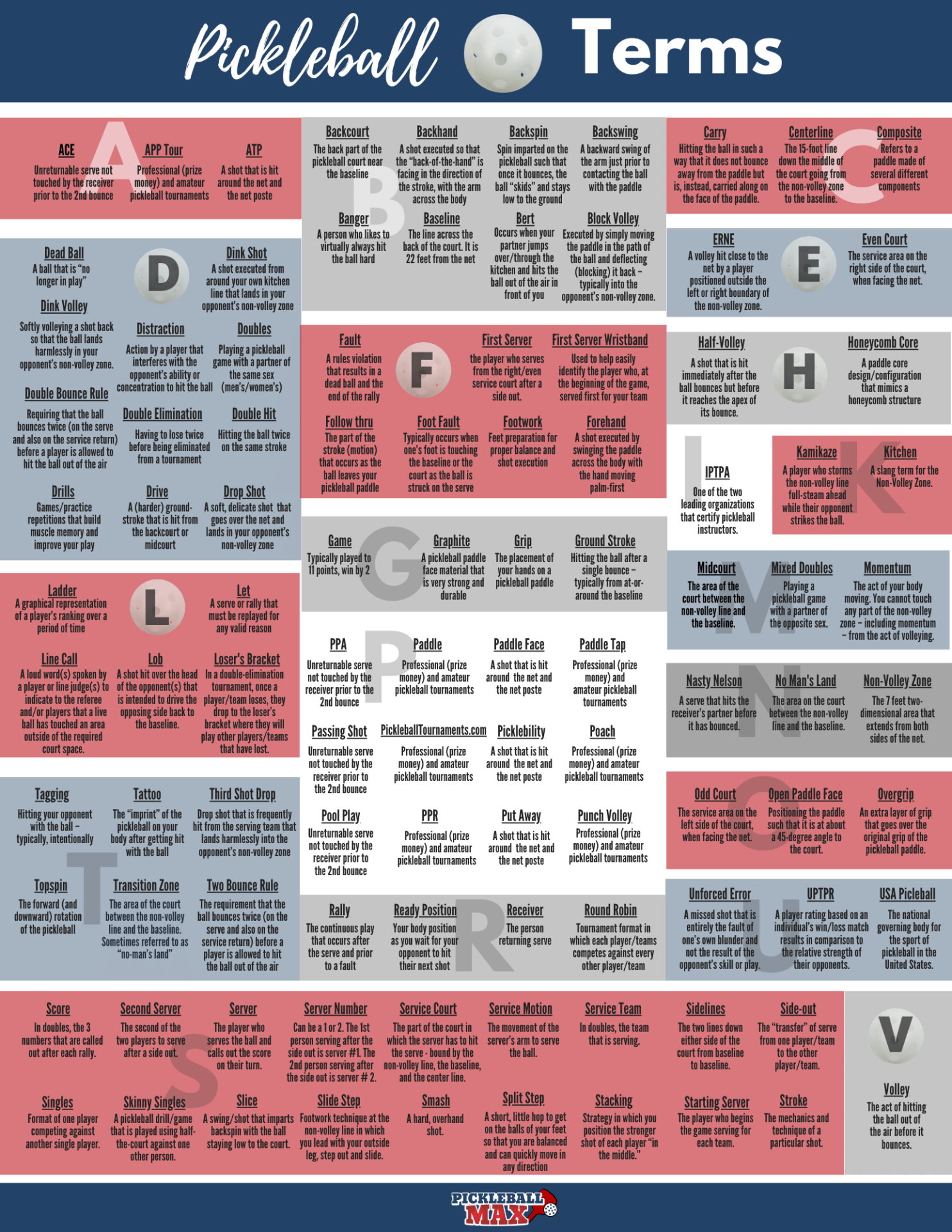
Pickleball has a unique set of terms, rules, and phrases that every player should understand. This glossary of 150+ pickleball terms and phrases referring to shots, rules, the court, paddles, and more gives simple definitions to assist you the next time you venture on the courts.
Additionally, if you are looking for DUPR, PPA, APP, MLP, and other abbreviations, see our pickleball acronyms guide.
[Updated June, 2026]
150+ Pickleball Terms and Phrases You May Hear on the Court
– A –
Ace – An ace is an unreturnable serve that is not touched by the receiver prior to the 2nd bounce.
Around-the-Post (ATP) – An ATP is a shot that is hit around the net post and lands in the opponent’s court.
Attackable Ball – An attackable ball is one that can be sped up aggressively because of where it is positioned.
– B –
Backcourt – The back part of the pickleball court near the baseline.
Backhand – A backhand is a shot executed so that the “back-of-the-hand” is facing in the direction of the stroke, with the arm across the body.
Backspin – Spin imparted on the pickleball such that once it bounces, the ball “skids” and stays low to the ground. Also known as a slice.
Backswing – A backward swing of the arm just prior to contacting the ball with the paddle.
Banger – A banger is a person who likes to virtually always hit the ball hard.
Baseline – The baseline is the line across the back of the court that is 22 feet from the net.
Bert – A Bert occurs when your partner jumps over/through the kitchen and hits the ball out of the air in front of you.
Blue Card – A blue card is a technical warning issued by a referee for unsportsmanlike conduct.
Block Volley – Most frequently hit from the backhand wing, the block volley is a volley that is executed by simply moving the paddle in the path of the ball and deflecting (blocking) it back – typically into the opponent’s non-volley zone. The block volley is executed with a paddle face that is perpendicular to the court.
Body Bag – A body bag is intentionally hitting your opponent with the ball to win the point.
– C –
Carry – Hitting the ball in such a way that it does not bounce away from the paddle but is, instead, carried along on the face of the paddle.
Centerline – The 15-foot line down the middle of the court, going from the non-volley zone to the baseline, dividing the even service court from the odd service court.
Championship Court – The main court that the top players play on when in a tournament or league.
Chicken Wing – The awkward body-position in which the elbow flares out while defending a speed-up hit at a player’s dominant shoulder.
Closed Face – The position of the paddle face when angled downward toward the court.
Composite – Refers to a paddle made of several different components (handle, core, paddle face, etc.)
Counterattack –A counterattack is returning an opponent’s attack with an offensive shot.
Counterpunch –A counterpunch is a controlled counterattack against a hard-driven ball.
– D –
Dead Ball – A ball that is “no longer in play.”
Dead Dink – A dead dink is a dink that lacks spin or pace and is easy to attack.
Delamination – Delamination of a paddle is when the carbon fiber plies come apart in the face sheet, resulting in a loss of structural integrity.
Dig – A defensive shot taken when the paddle is low, and the shot is typically hit at the feet. Players crouch low to absorb the power of the shot and try to reset it.
Dink – A dink is a soft shot that is hit into your opponent’s non-volley zone.
Dink Volley – A dink volley is when you take a dink shot hit by your opponent out of the air and softly volley it back such that the ball lands harmlessly in your opponent’s non-volley zone.
Distraction – A distraction is a physical action by a player that interferes with their opponent’s ability or concentration to hit the ball.
Doubles – Playing a pickleball game with a partner of the same sex (men’s/women’s).
Double Bounce – When the ball bounces twice on your side of the court before hitting it. Often confused with the two bounce rule.
Double Elimination – Double elimination is a tournament format in which you have to lose twice before being eliminated.
Double Hit – Hitting the ball twice on the same stroke.
Dream Breaker – A Dream Breaker is a team-based tie-breaking format (popularized by MLP) that is typically played to 21 points, with players switching out every four points.
Drills – Mimicking “real” play, drills are games/practice repetitions that build muscle memory and improve your play.
Drive – A drive refers to a (harder) ground-stroke that is hit from the backcourt or midcourt.
Drip – A drip shot that is a combination of a drive and drop shot.
Drop Shot – A drop shot is a soft, delicate shot hit from anywhere on the court that goes over the net and drops in your opponent’s non-volley zone.
DUPR Reliability Score – The score that DUPR assigns to a player, indicating how confident they are with their system’s rating.
Dwell Time – Dwell time is the exact amount of time the ball sits on the paddle’s face after impact.
Dynamic Universal Pickleball Rating (DUPR) – A global system that uses an algorithm for rating pickleball players.
– E –
Erne – The Erne is a volley hit by a player who jumps outside the court, close to the net positioned on the left or right boundary of the non-volley zone.
Even Court – The service area on the right side of the court, when facing the net.
– F –
Fault – A fault is a rules violation that stops play and results in a loss of the rally.
Firefight – A hands battle at the Non-Volley Zone line resulting in fast exchanges across the net.
First Server – When playing doubles, the player who serves from the right/even service court after a side out.
First Server Wristband – Used to help easily identify the player who, at the beginning of the game, served first for your team.
Flamingo – An offensive shot used to balance, counterbalance, and attack that is hit with a flamingo-like pose: one leg raised behind and leaning in to hit the ball.
Flick – A flick is a quick speed-up generated with the wrist.
Follow Thru – The part of the stroke (motion) that occurs as the ball leaves your pickleball paddle.
Foot Fault – A fault occurring when a player’s foot touches any part of the Non-Volley Zone during the act of volleying the ball.
Footwork – Feet preparation for proper balance and shot execution.
Forehand – Opposite of the backhand, the forehand is a shot executed by swinging the paddle across the body with the hand moving palm-first.
– G –
Game – Typically played to 11 points, win by 2.
Golden Pickle – A golden pickle is when the first server wins the game 11-0 without the other team ever getting a chance to serve.
Graphite – A pickleball paddle face material that is very strong and durable.
Grip – The placement of your hands on a pickleball paddle.
Ground Stroke – A ground stroke is hitting the ball after a single bounce – typically from at or around the baseline.
– H –
Half Stack – A half stack is when players stack only when serving, not when receiving.
Half-Volley – A half-volley is a shot that is hit immediately after the ball bounces but before it reaches the apex of its bounce.
Hand’s Battle – A hand’s battle is when players hit fast volleys across the net while being positioned at the Non-Volley line.
Heavy Ball – A heavy ball is a shot that feels unusually difficult to handle because of its pace or spin.
Hinder – A hinder is any occurrence not caused by a player that adversely impacts play.
Honeycomb Core – A paddle core design/configuration that mimics a honeycomb structure.
– I –
Inside-Out Forehand – A shot where a player moves around a ball to hit it from their backhand side of the court (using a forehand grip) across their body to their opponent’s backhand side.
– K –
Kamikaze – A player who storms the Non-Volley line full-steam ahead while their opponent strikes the ball.
Kitchen (Non-Volley Zone) – The kitchen is the area on each side of the net where players are not allowed to hit the ball out of the air while standing inside it.
– L –
Ladder – A graphical representation of a player’s ranking over a period of time.
Lemon Drop – A lemon drop is a perfectly executed third-shot drop or a dink that is exceptionally well-placed and unattackable.
Let – A serve or rally that must be replayed for any valid reason.
Line Call – A hand signal or loud word(s) spoken by a player or line judge(s) to indicate to the referee and/or players that a live ball has touched an area outside of the required court space.
Lob – A lob is a shot hit over the head of the opponent(s) that is intended to drive the opposing side back to the baseline.
Loser’s Bracket – In a double-elimination tournament, once a player/team loses, they drop to the loser’s bracket where they will play other players/teams that have lost.
– M –
Match Point – Match point is when a team is 1 point away from winning.
Midcourt – Midcourt is the area of the court between the Non-Volley line and the baseline.
Misdirection Shot – A shot hit with an open paddle face, pushing the ball straight at your unsuspecting opponent.
Mixed Doubles – Playing a pickleball game with a partner of the opposite sex.
Momentum – Momentum is a player’s movement after hitting a ball.
– N –
Nasty Nelson – An intentional serve that hits the receiver’s partner before it has bounced.
No Man’s Land – No Man’s Land is the transition area on the court between the Non-Volley line and the baseline.
Non-Volley Zone (Kitchen) – The 7-foot two-dimensional area that extends from both sides of the net.
– O –
Odd Court – Odd court is the service area on the left side of the court, when facing the net.
Open Paddle Face – Open paddle face is positioning the paddle such that it is at about a 45-degree angle to the court.
Overgrip – Overgrip is an extra layer of grip that goes over the original grip of the pickleball paddle.
– P –
Pace – Pace is the overall rhythm of a rally by dictating the tempo of the game.
Paddle – A paddle is what you use to hit a pickleball.
Paddle Deflection – Paddle deflection refers to how the paddle responds to the pressure of a ball upon impact.
Paddle Face – Paddle face is the smooth, hitting surface of the paddle.
Paddle Tap – In a show of sportsmanship, a paddle tap is tapping the butt of your paddle handle with your partner and the other player/team after concluding a game.
Pancake – A pancake is a shot using the Western grip that looks like flipping a pancake with a spatula.
Passing Shot – A passing shot is a drive (groundstroke) that passes your opponent who is positioned at or near the Non-Volley line.
Permanent Object – A permanent object is any object near the court that can interfere with play if hit.
Pickleball Brackets – Pickleball tournament management software under the Pickleball.com umbrella.
Pickleballtv – Pickleballtv is the official 24/7 network for pickleball.
Picklebility – Coined by PickleballMAX.com, picklebility is “an embodiment of one’s passion, ability, and addiction to pickleball.”
Pickled – Pickled is a term used to describe a team that lost without scoring a point.
Player Position – Player position refers to where a player should stand on the court during certain plays.
Poach – A poach is the act of moving across (and sometimes in front of your partner) to volley the ball out of the air.
Pool Play – A tournament format in which similarly skilled players/teams are grouped together in different buckets, or pools.
Put Away – A put-away is hitting a shot that isn’t returned.
Punch Volley – A punch volley is hitting the ball with a paddle face that is perpendicular to the court, perhaps slightly open, in a forward “punching” motion.
– Q –
Questionable Call – Questionable calls are those calls that are undecided, typically resulting in favor of the opponent, or in a replay.
– R –
Rally – A rally is the continuous play that occurs between players after the serve and prior to a fault.
Rally Scoring – Differing from traditional pickleball scoring, a point is awarded to whichever team wins the rally – be it the serving team or the non-serving team.
Ready Position – Ready position is your body position as you wait for your opponent to hit their next shot.
Receiver – The receiver is the person returning the serve.
Reset – A reset is a soft, defensive shot that lands harmlessly into the opponent’s non-volley zone such that the opponent can no longer exert offensive pressure without significant risk.
Roll Volley – A roll volley is a firm, half-swinging volley imparted with forward spinning motion on the ball, causing the ball to drop and propel forward after the bounce.
Round Robin – Round Robin is a tournament format in which each player/team competes against every other player/team.
– S –
Sandbag – Sandbag refers to players who play a tournament at a lower level than what they are officially ranked.
Score – Score is the 3 numbers that are called out after each rally in doubles.
Scorpion – The scorpion is a counter-attack shot in which the attacked player (positioned at the Non-Volley line) squats low to the court, raises their paddle above their head, and smashes the ball back at their opponent’s feet or into the open court.
Second Server – When playing doubles, the second of the two players to serve after a side out.
Serve – A serve is the underhand shot that begins each point.
Server – A server is the player who serves the ball and calls out the score on their turn.
Server Number – The server number is 1 or 2, depending on whether you are the first person serving after the side out or the second person serving after the side out.
Service Court – The part of the court bound by the non-volley line, the baseline, and the centerline in which the server has to hit the serve.
Service Motion – Service motion is the movement of the server’s arm (includes both backswing and forward swing) to serve the ball.
Service Team – The service team in doubles is the team that is serving.
Shake and Bake – Shake and bake is when one player from the serving team drives the ball on the third shot while their partner “crashes” forward to the middle ahead of the player striking the ball in hopes of putting away a weak volley from the team already positioned at the Non-Volley line.
Sidelines – Sidelines are the two 44-foot lines down either side of the court from baseline to baseline.
Side-out – Side-out describes the “transfer” of the serve from one player/team to the opposing player/team after losing the rally.
Singles – Singles is a format of one player competing against another single player.
Skinny Singles – Skinny Singles is a pickleball drill/game that is played using half the court against one other person.
Slice – A slice is a swing/shot that imparts backspin with the ball staying low to the court.
Slide Step – Slide step is a footwork technique at the Non-Volley line in which you lead with your outside leg and step out and slide.
Smash – A smash is a hard, overhand shot.
Speed-Up – A speed-up is a shot where a player suddenly hits a soft ball harder and faster at their opponents to catch them off guard and change the pace of the rally.
Split Step – Split step is a short, quick, balanced hop to get a player transitioned from the baseline to the non-volley line.
Stacking – Stacking is a strategy in which you position the stronger shot of each player “in the middle.”
Starting Server – The starting server is the player who begins the game serving for each team.
Static Weight – Static weight is the weight of a paddle when you put it on a scale.
Stroke – A stroke is the mechanics and technique of a particular shot.
Sweet Spot – The sweet spot is the spot in the center of the hitting surface of a paddle.
Swing Weight – Swing weight refers to how heavy it feels while you swing the paddle.
Switch – Switch is when partners change positions on the court to ensure each player hits from their preferred side.
– T –
Tagging – Tagging refers to hitting your opponent with the ball – typically, intentionally.
Tattoo – The “imprint” of the pickleball on your body after getting hit with the ball.
Third Shot Drive – A third shot drive is a (harder) ground-stroke hit from the serving team after the return of serve.
Third Shot Drop – A third shot drop is a soft shot hit from the serving team after the return of serve, which lands into the opponent’s non-volley zone.
Topspin – Topspin is the word used to describe the forward (and downward) rotation of the pickleball.
Transition Zone – The transition zone is the area of the court between the Non-Volley line and the baseline.
Triple Crown – A triple crown is winning gold in 3 events (doubles, singles, mixed) during a pickleball tournament.
Tweener – A tweener is a shot hit between the legs.
Two-Bounce Rule – A unique rule in pickleball that refers to the requirement that the ball bounces twice (on the serve and also on the service return) before a player is allowed to hit the ball out of the air.
Twoey –A twoey is a term made famous by Connor Garnett for a two-handed backhand shot.
Two-Handed Backhand –A two-handed backhand is a backhand shot hit with both hands holding the paddle.
– U –
Unforced Error – An unforced error is a missed shot that is entirely the fault of one’s own blunder and not the result of the opponent’s skill or play.
USA Pickleball – USA Pickleball is the national governing body for the sport of pickleball in the United States.
– V –
Volley – A volley is the act of hitting the ball out of the air before it bounces on the court.
Volley Counter – A volley counter is a volley shot used to redirect an opponent’s shot back at them.
– Y –
Yips – Yips is the term used to describe someone who can’t get their serve in the service box.
FAQs
What is an Erne?
The Erne is a volley hit close to the net by a player positioned outside the left or right boundary of the non-volley zone. It was named after Erne Perry.
What does ATP mean in pickleball?
ATP means Around the Post.
What is a pickleball banger?
A pickleball banger is a player who likes to virtually always hit the ball hard.
What does getting pickled mean?
A term used to describe a team that lost without scoring a point.
Related Articles
- Complete Guide to Pickleball Rules
- Pickleball 101
- Pickleball Acronyms and Abbreviations
- What is Pickleball
Dictionary of Pickleball Terms
There you have it – a dictionary of pickleball terms and even a little slang! Hope this helps as you navigate the pickleball court! Admit it, some terms used in pickleball are funny and strange! No other sport refers to the Sesame Street characters Bert and Erne, or part of their court being referred to as a kitchen. Now you know what they mean.
Are there any other pickleball terms that you use on the court that aren’t mentioned in our list? Be sure to add them in the comments below.
See you on the courts!


Pickleball Doubles Strategy Blueprint
Jigsaw Health – Discount Code!
Use Code “PickleballMAX10” at Checkout for 10% off your Jigsaw Order.
RIA Performance Eyewear